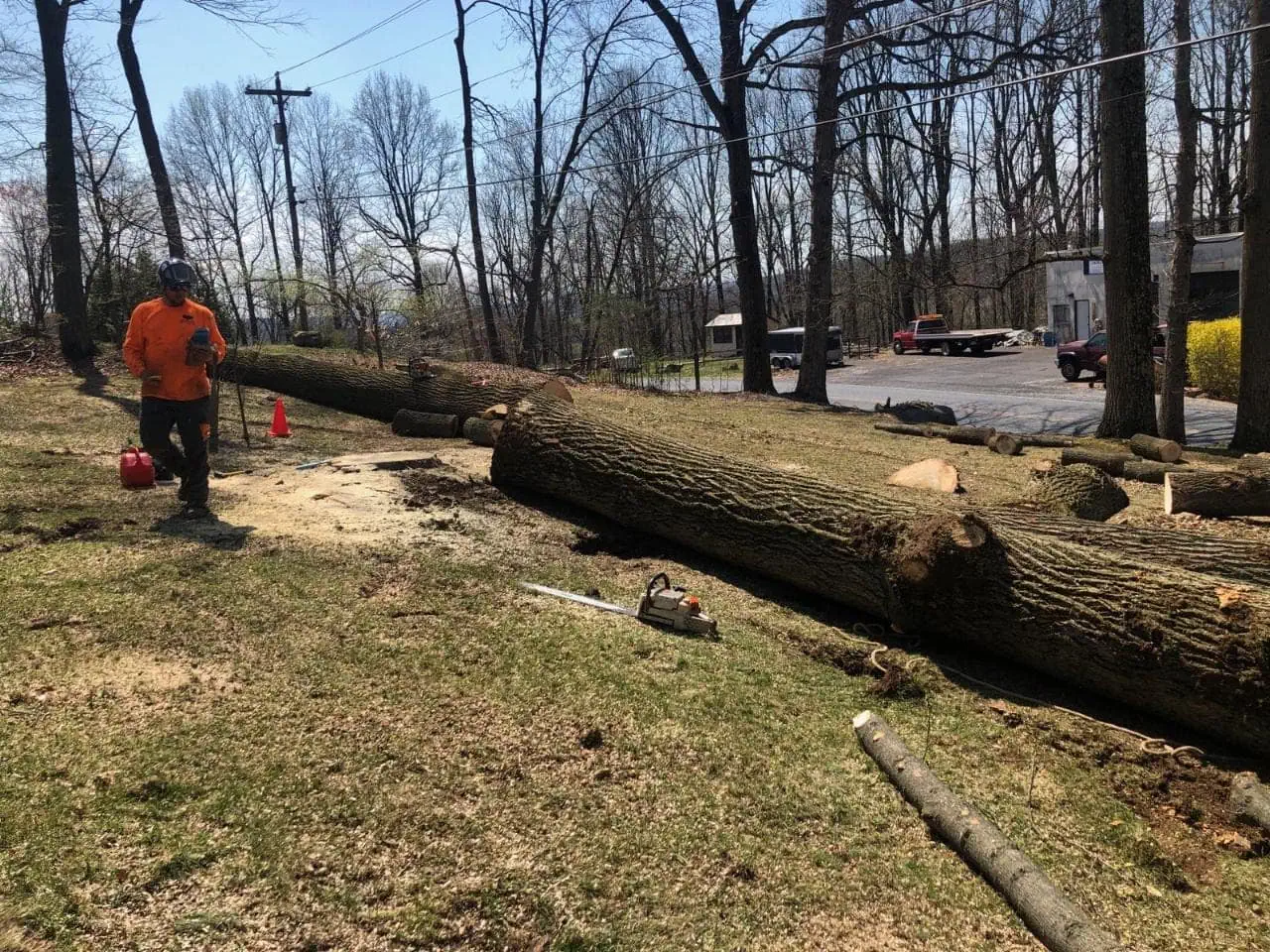
Storm damage tree cleanup Reading Pennsylvania property owners need this season is not just about dragging limbs to the curb after the weather clears. June hit Berks County with the kind of unsettled, fast-changing weather that makes trees show their weak points, including severe wind and hail on June 6 and 7, the unusual “gustnado” reported in Marion Township on June 9, and the tornado warning that pushed across southern Berks on June 22.
A lot of trees in Reading, Sinking Spring, Fleetwood, Oley, Mt. Penn, Exeter, and the farm-and-woodlot edges near Marion Township took more stress than most people could see from the driveway. The obvious damage was easy to spot, such as snapped limbs, shredded leaves, and branches scattered across yards, but the more important damage often sits deeper in the tree.
That is where the problem starts. A cracked union, loosened root plate, split leader, or canopy that suddenly lost a major limb can sit quietly for days or weeks, then fail when the next thunderstorm comes through Berks County with wet soil and a hard wind shift.
The good news is that educated, local tree care can reduce that risk. Bolder Quality Tree Care, led by owners and arborists Rick and Steve, brings years of hands-on experience, and a community-rooted approach to helping Berks County homeowners and commercial property owners understand what happened, what needs cleanup, and what can be prevented before the next storm.
The Science of Wind: What the June Gustnado Did to Berks County Trees
Sudden wind events damage trees because they load the crown faster than the trunk, branches, and roots can adjust. When wind hits a tree in a yard off Penn Avenue in Sinking Spring or along a more open property near Fleetwood, the canopy catches that moving air like a sail, the trunk bends and rebounds like a living spring, and the roots try to hold everything in place while the soil itself may be shifting.
During the June 9 gustnado in Marion Township, trees in western Berks likely faced short-lived but intense rotating wind near the ground. A gustnado is not the same as a classic tornado, but for a tree standing beside a barn, driveway, hedgerow, or field edge, the difference may not feel all that comforting when the wind suddenly twists the crown from a new angle.
That twisting matters. Straight-line wind tends to push the canopy in one main direction, while a rotating or rapidly shifting gust can torque branches, pull on old storm wounds, and force co-dominant stems to fight against each other in a matter of seconds.
The June 6 and 7 severe wind and hail events added another kind of injury. Hail can bruise leaf tissue, shred tender new growth, nick thin bark, and create small wounds that later become entry points for decay fungi or insect activity, especially on already stressed trees.
Wind does something different. It bends stems past their normal range, snaps overloaded limbs, and exposes the weak places where wood fibers, included bark, decay pockets, or old pruning cuts have already reduced strength.
The tornado warning in southern Berks on June 22 gave property owners another reminder that tree risk does not stop at one township line. Reading, Mt. Penn, Exeter, Sinking Spring, Fleetwood, Oley, and rural properties around Marion Township all have changing wind exposure because the county mixes hills, valleys, open fields, creek corridors, older neighborhoods, and newer commercial development.
Tree species also respond differently to that kind of weather. Silver maples and Bradford pears often fail at tight branch unions, older Norway maples may split where included bark has been trapped for years, and oaks can look solid in the crown but still become dangerous if root systems were weakened by saturated soil, trenching, compaction, or decay.
Roots deserve special attention after heavy rain and wind. When Berks County clay soils get saturated, fine roots lose some gripping power, and the root plate can begin to rotate under pressure, which may leave a tree with a new lean, fresh soil heaving, or crescent-shaped cracks around the base.
Branch unions are another common failure point. A strong union builds overlapping wood that acts like a natural brace, while a weak union traps bark between two stems and prevents strong connective wood from forming.
That is why storm damage is not always obvious right after cleanup. A branch can remain attached while cracked inside, a trunk can twist and split beneath the bark, and roots can loosen enough to matter without the whole tree falling immediately.
Why Storm Damage Tree Cleanup Reading Pennsylvania Requires an Arborist
Storm damage tree cleanup Reading Pennsylvania properties require should be guided by a trained arborist because storm-damaged trees can fool the eye. A limb that looks like simple debris from the ground may be under tension, pinned against a roof, hooked into another limb, or attached to a trunk that has already split higher than you can see.
The science matters because wind damage changes the way weight moves through a tree. Once one large limb breaks, the remaining canopy carries weight differently, and that imbalance can increase the chance of future failure during the next round of wind.
According to the National Weather Service, severe thunderstorm winds are defined as winds of 58 miles per hour or greater. That number matters in Berks County because storms do not need a confirmed tornado to break limbs, tear out weak unions, and bring down trees across neighborhoods from Reading to Fleetwood.
An arborist reads the whole tree, not just the broken piece lying on the lawn. That means checking the root flare, trunk taper, branch spacing, canopy weight, decay pockets, fungal growth, cracks, cavities, wound response, and the direction and history of lean.
For homeowners in Reading, PA, this can be the difference between removing one hazardous limb and missing a larger structural problem above the roofline. For commercial property owners, the same decision may affect sidewalks, parking lots, signs, tenant entrances, loading areas, and customer access.
Storm cleanup also depends on the right sequence. Cut the wrong limb first, and stored energy can release suddenly, a trunk can roll, or a hanging branch can drop into the exact spot where someone expected it to stay put.
That is why emergency tree removal Reading PA property owners request after storms should never be treated like routine yard cleanup. A certified arborist near me Berks County search should lead to someone who understands tree biology, storm loading, rigging, equipment access, and risk assessment.
Bolder Quality Tree Care is educated in the science of trees, which means Rick and Steve look beyond the mess. They assess why the failure happened, whether the remaining tree can recover, and whether nearby trees have the same risk factors waiting for the next severe weather day.
Preventative Pruning: The Best Defense Against the Next Storm
Preventative pruning reduces storm risk by removing weak, dead, diseased, crossing, and poorly attached branches before high winds test them. It does not make a tree storm-proof, but it can help the canopy move more evenly and reduce the chance that one failing limb will damage a home, garage, vehicle, walkway, fence, or business entrance.
Good pruning starts with deadwood removal. Dead branches are dry, brittle, and often colonized by decay organisms, so they are more likely to snap when a fast-moving thunderstorm hits places like Reading, Sinking Spring, or Fleetwood with a sudden gust.
Canopy thinning can help too, but only when someone does it with restraint and purpose. The goal is not to strip the tree, lion-tail the limbs, or raise the canopy until it looks bare, but to reduce selected density so wind can pass through the crown with less drag.
Structural pruning is especially valuable for younger and middle-aged trees. By improving branch spacing, shortening overextended limbs, reducing co-dominant stems, and correcting weak unions early, an arborist can guide the tree toward stronger architecture before it becomes large, heavy, and expensive to manage.
Here is why that matters. A young maple near a driveway in Sinking Spring with two equal leaders may look full and healthy today, but if those stems keep growing together with included bark between them, one hard wind shift ten years from now could split the tree open.
Professional knowledge matters because poor pruning can make storm problems worse. Over-pruning can stress a tree, expose bark to sunscald, trigger weak sucker growth, reduce stored energy, and leave large wounds that do not close well.
A proper plan for tree pruning considers the tree’s species, age, health, location, targets, and past storm exposure. A mature oak near a home in Oley needs a different pruning strategy than a row of maples near a commercial lot in Reading or a pear tree near a driveway in Sinking Spring.
Preventative pruning also gives arborists a chance to find hidden issues before they become emergencies. While working in the canopy, they may spot cracks, old storm wounds, decay, insect activity, rubbing limbs, weak attachments, or sections of the crown that are carrying too much end weight.
For Berks County properties, the best time to think about pruning is before the next warning lights up a weather app. June showed how quickly conditions can change, and a proactive inspection gives property owners clearer options before wind, rain, and hail arrive together.
Hidden Hazards: What to Look for After Severe Weather
After severe weather, the safest first step is to look from a distance before walking under or near damaged trees. If you see hanging limbs, fresh cracks, a new lean, bark torn away, or branches touching a roof, service line, garage, shed, or fence, treat the area as unsafe until a trained professional evaluates it.
One common hazard is a “hanger,” which is a broken limb caught in the canopy. These branches can fall without much warning when wind returns, the wood dries, another limb shifts, or gravity finally wins the little battle that was holding it in place.
Fresh soil movement near the base of a tree is another warning sign. If the ground is raised, cracked, sunken, or separated on one side, the root plate may have shifted during the storm, especially in wet clay soil or along sloped yards common around parts of Berks County.
Cracks in the trunk or major limbs are serious too. A vertical crack may show that the trunk twisted under load, while a split at a union can mean the tree’s main framework has been weakened and may no longer distribute weight safely.
Look closely at co-dominant stems, especially on maples, pears, elms, and other trees with tight V-shaped unions. These spots often trap included bark, and when sudden wind pushes the two stems in different directions, the union can open like a zipper.
Leaf and twig damage can matter, even when the tree is still standing. After hail, shredded leaves and small wounds may not call for removal, but they can reduce photosynthesis and add stress to trees already dealing with drought, compacted soil, poor drainage, root restriction, or disease.
Commercial sites need a careful look after storms because risk often involves access and visibility. Branches over parking areas, pedestrian paths, loading zones, outdoor seating, signs, and entrances can create hazards even when the tree itself looks mostly upright from across the lot.
Homeowners should avoid judging tree safety only by whether the tree is still standing. Many trees that fail later were partly compromised in an earlier storm, then finished off by the next round of wind, wet soil, or sudden directional gusts.
If you are unsure what you are seeing, take photos from a safe location and keep people away from the area. A professional tree service Berks County property owners trust can inspect the tree and explain whether pruning, monitoring, cabling, plant health care, or removal is the right next step.
How Bolder Quality Tree Care Responds to Emergencies
Bolder Quality Tree Care responds to tree emergencies by combining rapid field action with arborist-level judgment. Storm work is not only about speed, because safe cleanup depends on understanding tree structure, weight distribution, nearby targets, ground conditions, and what may fail next.
When a storm brings down limbs in Reading, Sinking Spring, Fleetwood, Oley, Mt. Penn, Exeter, or Marion Township, the first priority is safety. Crews must evaluate access, overhead hazards, wet turf, slopes, pressure points, broken branch attachments, and the position of the tree or limb before making cuts.
Rick and Steve bring local experience to that decision-making process. As owners and arborists, they know how Berks County trees grow in clay soils, sloped yards, tight city lots, older neighborhoods, wooded edges, farm lanes, and developed commercial sites.
They also understand how recent weather history affects current risk. A tree that took severe wind on June 6 and 7, then hail damage, then more stress during the June 22 tornado warning period may not respond like a healthy tree that has been standing in calm summer weather.
Emergency tree care can include removing broken limbs, clearing access routes, stabilizing partially failed trees, reducing immediate hazards, and assessing whether the remaining structure is viable. Sometimes selective pruning can preserve a tree, while other times removal is the safest and most responsible option.
When a tree is beyond recovery, tree removal may be needed to protect people, buildings, vehicles, utility areas, or neighboring properties. The key is making that decision based on evidence, not fear, guesswork, or the assumption that every damaged tree must come down.
Bolder Quality Tree Care also looks at the surrounding trees. Storms often expose a pattern, such as several trees with weak unions, root restriction, decay, buried root flares, poor past pruning, or canopies that have grown too heavy on one side.
That bigger view helps property owners who want to prevent repeat damage. If one tree failed because it had poor structure, another nearby tree of the same age and species may deserve a closer inspection before the next line of storms moves through Berks County.
Frequently Asked Questions
What should I do first if a storm damages a tree on my property?
Stay away from the damaged area and look for hazards from a safe distance. Bolder Quality Tree Care recommends keeping people, pets, and vehicles away from hanging limbs, leaning trunks, cracked branches, and trees that shifted during storms in Reading, PA. Do not cut limbs that are under tension or resting on structures because they can move suddenly once the first cut changes the weight. In Berks County, storm-damaged trees should be assessed by trained arborists who understand both cleanup safety and tree structure.
How do I know if my tree needs pruning or removal after wind damage?
The answer depends on the tree’s structure, root stability, canopy loss, decay, and location near targets. Bolder Quality Tree Care evaluates whether the remaining tree can safely recover or whether removal is the responsible choice in Berks County. A tree with minor broken branches may only need corrective pruning, while a tree with a split trunk, major canopy loss, or lifted root plate may be unsafe. In Reading, PA, an arborist inspection helps avoid both unnecessary removals and overlooked hazards.
Can preventative pruning really reduce storm damage?
Yes, proper pruning can reduce risk by removing deadwood, improving branch spacing, and reducing weak canopy connections. Bolder Quality Tree Care uses science-based pruning methods that support tree health and structure across Berks County. Pruning cannot stop all storm damage, especially during extreme wind, hail, gustnado activity, or tornado-warned storms. However, in Reading, PA, well-maintained trees often handle sudden weather better than neglected trees with heavy, unbalanced crowns.
Why should I hire a certified arborist instead of a general cleanup crew?
A certified arborist understands how trees grow, fail, recover, and respond to pruning or removal decisions. Bolder Quality Tree Care brings that level of tree science to storm cleanup in Reading, PA and nearby communities. General cleanup may remove debris, but it may not identify cracked unions, root plate movement, hidden decay, or canopy imbalance left behind after the storm. For Berks County property owners, that knowledge can help prevent a damaged tree from becoming a future emergency.
Do commercial properties need storm tree assessments too?
Yes, commercial sites often have higher exposure because trees may be near parking lots, sidewalks, signs, tenants, employees, and customers. Bolder Quality Tree Care helps Berks County businesses evaluate tree hazards after wind, hail, and severe thunderstorms. A damaged limb over a walkway, entrance, or loading area can create risk even if the tree looks mostly normal from a distance. In Reading, PA, proactive assessments help property managers plan safer maintenance before the next severe weather event.
Schedule Your Post-Storm Tree Assessment Today
A proactive tree assessment can help you understand which trees are safe, which need pruning, and which may become hazards during the next strong storm. If June’s severe wind, hail, gustnado activity in Marion Township, or tornado warning in southern Berks raised concerns on your property, now is the right time to have your trees reviewed by educated local arborists.
Rick and Steve at Bolder Quality Tree Care are rooted in Berks County and trained in the science of trees. Homeowners and commercial property owners in Reading, Sinking Spring, Fleetwood, Oley, Mt. Penn, Exeter, and surrounding communities can schedule a proactive assessment and get a quote before the next storm tests the canopy.