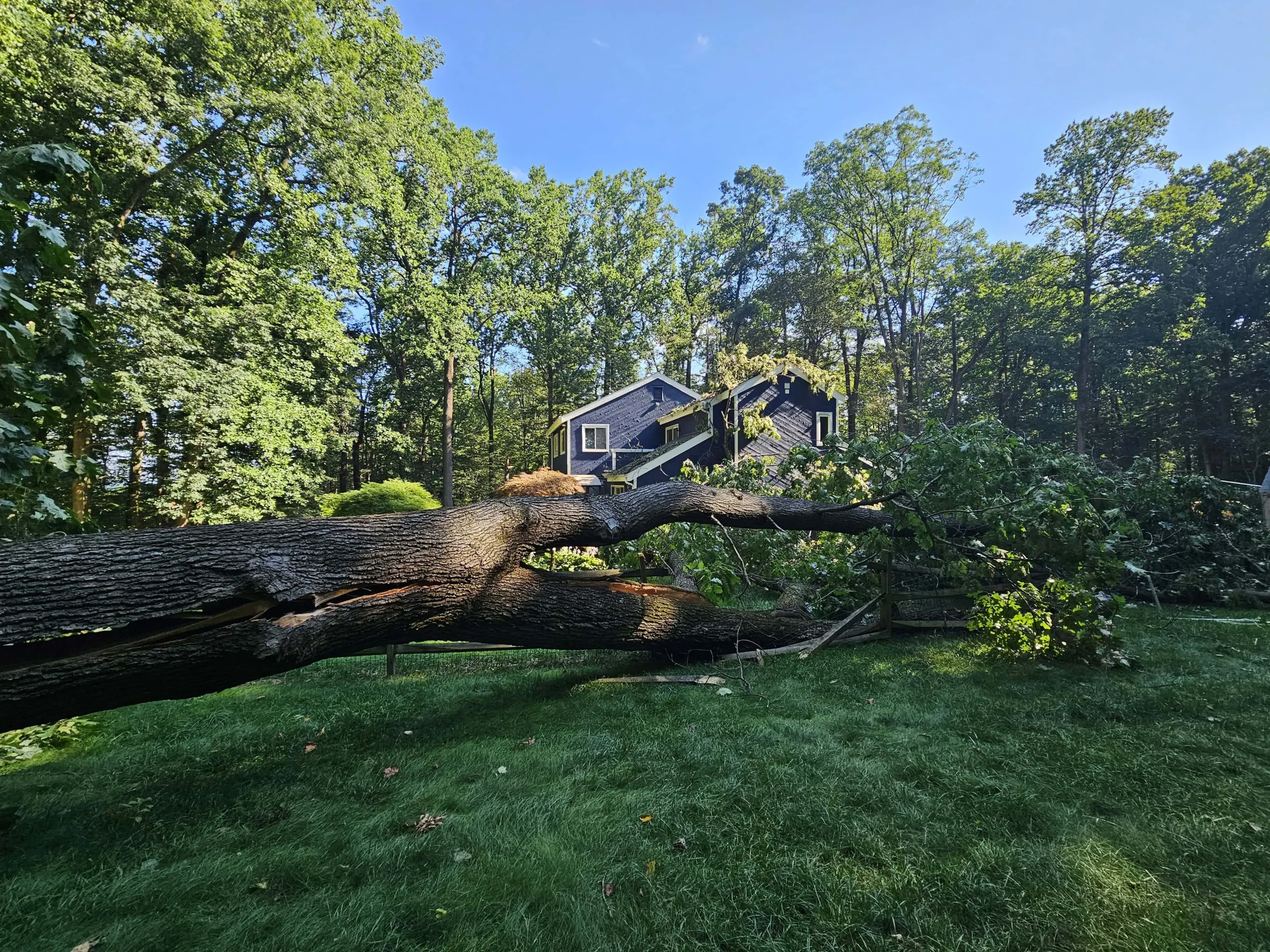
The late-July storms reminded Berks County property owners how quickly a summer weather system can change the condition of a landscape. Heavy rain can saturate the soil while strong wind loads tree canopies, breaks limbs, exposes weak branch unions, and sometimes shifts the root plate beneath a tree that still appears to be standing normally.
For homeowners in Reading, Sinking Spring, Fleetwood, Oley, Mt. Penn, Exeter, and nearby communities, recovery should begin with safety and observation. Storm cleanup is not simply a matter of dragging branches to the curb. A damaged limb may be under tension, a cracked trunk may fail later, and a tree with loosened roots may become more dangerous when the next gust or rain event arrives.
Bolder Quality Tree Care helps property owners make informed decisions after severe weather. Our expert tree service providers are educated in tree biology and bring more than 20 years of Pennsylvania experience to storm damage assessment, emergency tree work, pruning, removal, and restoration. We combine rapid response with a careful process designed to protect people, structures, vehicles, and the long-term health of the landscape.
Start with a Safety-First Storm Assessment
The first step after a severe storm is to look from a safe distance. Walk around the property only when conditions allow, and do not stand beneath damaged trees or approach branches that are hanging, split, or caught in the canopy. If a tree or limb is touching a power line, keep away and contact the utility provider. Electrical hazards require specialized response.
Look for obvious warning signs such as a new lean, fresh cracks, bark torn from the trunk, broken leaders, large limbs resting on a roof or vehicle, and soil that is raised, cracked, or separated near the base of a tree. These conditions can indicate movement in the trunk, branch structure, or root plate.
Storm damage can also be hidden. A tree may retain most of its canopy while carrying a cracked union or partially detached limb high above the ground. That is why professional assessment matters, especially when damage is near a home, driveway, fence, sidewalk, parking area, business entrance, or neighboring property.
Why Late-July Storms Can Create Delayed Tree Hazards
Wind does not need to produce a tornado to cause serious tree damage. Sudden gusts bend branches beyond their normal range, increase pressure on weak attachments, and redistribute weight when a major limb breaks. Once part of the canopy is lost, the remaining structure may carry an uneven load during the next weather event.
Heavy rain adds another layer of concern. Saturated soil may reduce the holding power of fine roots, particularly on slopes, in compacted areas, and in Berks County soils that hold moisture. Fresh soil heaving or a crescent-shaped gap near the trunk can suggest that the root plate has shifted.
Hail and wind can also leave small wounds that do not look urgent at first. Torn leaves, scraped bark, and broken twigs can add stress to trees already dealing with disease, decay, drought, poor drainage, or restricted roots. An experienced tree service provider can distinguish cosmetic damage from conditions that require immediate action.
What Professional Storm Damage Cleanup Involves
Safe storm cleanup depends on sequence, equipment, and judgment. A broken limb may be suspended by neighboring branches, pinned against a structure, or loaded with enough stored energy to move suddenly when cut. The safest approach is to evaluate the tree, identify pressure points, establish a work area, and select a removal or stabilization method that protects the surrounding property.
Bolder Quality Tree Care begins by considering the whole situation: the tree’s species and condition, the location of the damage, nearby targets, access for equipment, ground conditions, overhead hazards, and the likelihood of additional failure. This allows our team to recommend the appropriate combination of emergency limb removal, tree removal, cleanup, pruning, monitoring, or plant health care.
Our goal is not to recommend removal automatically. In some cases, careful pruning can reduce risk and preserve a healthy tree. In other cases, a tree has lost too much structural integrity or is positioned too close to a target, making professional removal the most responsible option. We explain the reasoning so property owners can make decisions with confidence.
How to Protect Your Home or Business During Cleanup
Keep children, pets, tenants, and customers away from the work area. Move vehicles only if it is safe to do so, and avoid pulling on or cutting hanging branches yourself. Even a small limb can shift unexpectedly, while larger wood may roll, swing, or fall farther than expected.
For commercial properties, the inspection should include parking areas, sidewalks, loading zones, signs, outdoor seating, entrances, and access routes. A tree that looks stable from across a lot may still present a target risk above a walkway or customer area. Regular inspections and proactive pruning can reduce the chance of a future emergency.
For residential properties, pay particular attention to trees near roofs, garages, driveways, fences, play areas, and utility service lines. Photographs taken from a safe distance can help explain what happened when you contact a professional, but they should never replace an in-person assessment when structural damage is possible.
Proactive Pruning Helps Prepare for the Next Storm
Once immediate hazards are addressed, the next step is prevention. Proactive pruning can remove deadwood, reduce selected overextended branches, improve spacing, and address weak or crossing growth before high winds test the canopy. It cannot make a tree storm-proof, but it can help reduce avoidable risk and support healthier structure.
Good pruning is tailored to the tree. A mature oak near a home in Oley may need a different approach than a maple beside a driveway in Sinking Spring, a pear near a commercial entrance in Reading, or a row of trees along a Fleetwood property line. Species, age, health, past damage, and nearby targets all matter.
Over-pruning can create new problems, so the objective is not to strip the canopy or make a tree look bare. Our expert tree service providers use their knowledge of tree biology to recommend work that balances safety, appearance, recovery, and long-term health.
Why Choose Bolder Quality Tree Care After a Storm?
Bolder Quality Tree Care is a locally-owned and operated team serving Reading and surrounding Berks County communities. Owners and expert tree service providers Rick and Steve bring more than 20 years of experience, personalized service, and a commitment to the latest techniques and professional safety standards.
We provide emergency tree services, storm damage response and cleanup, tree pruning, tree removal, stump removal and grinding, lot clearing, tree planting, plant health care, and residential, commercial, and municipal tree services. Whether you need immediate help after a storm or a plan to prevent costly damage, we assess your specific situation and recommend a tailored solution.
Our team is fully licensed and insured, and we understand that storm damage can feel overwhelming. We are here to provide clear communication, skilled work, and practical next steps for your outdoor space.
Frequently Asked Questions
What should I do first after a storm damages a tree?
Look from a safe distance, keep people and pets away, and identify obvious hazards such as hanging limbs, fresh cracks, new lean, soil movement, or contact with a power line. Do not attempt hazardous cutting. Call the utility company for electrical concerns and contact a professional tree service for assessment and cleanup.
How quickly can Bolder Quality Tree Care respond to an emergency?
We provide rapid response for fallen trees, storm damage, and hazardous conditions in Reading and surrounding Berks County communities. Call us for immediate assistance with an urgent tree situation.
Can a damaged tree be saved after a severe storm?
Sometimes. The answer depends on the amount and location of damage, the tree’s species and health, the condition of its roots and trunk, and the targets around it. Our expert tree service providers evaluate the structure and explain whether pruning, stabilization, monitoring, plant health care, or removal is appropriate.
Do you provide storm cleanup for businesses and municipalities?
Yes. Bolder Quality Tree Care provides residential, commercial, and municipal services, including emergency response, hazardous limb removal, tree removal, cleanup, inspections, and proactive maintenance plans.
Do you offer free estimates?
Yes. We provide free estimates and quotes for our tree services. Call us or visit our site to schedule a consultation.
Recover Safely with Expert Local Tree Service
The late-July storms may have passed, but their effects can remain in damaged canopies, weakened roots, and hidden structural defects. If you are unsure whether a tree is safe, do not wait for the next storm to answer the question. Contact Bolder Quality Tree Care for a professional assessment and clear recommendations.
Call us or visit our site to request your free quote. Bolder Quality Tree Care is proud to serve Reading, Sinking Spring, Fleetwood, Oley, Mt. Penn, Exeter, and surrounding Berks County communities.